TWO OCEANS.ONE RAILROAD.
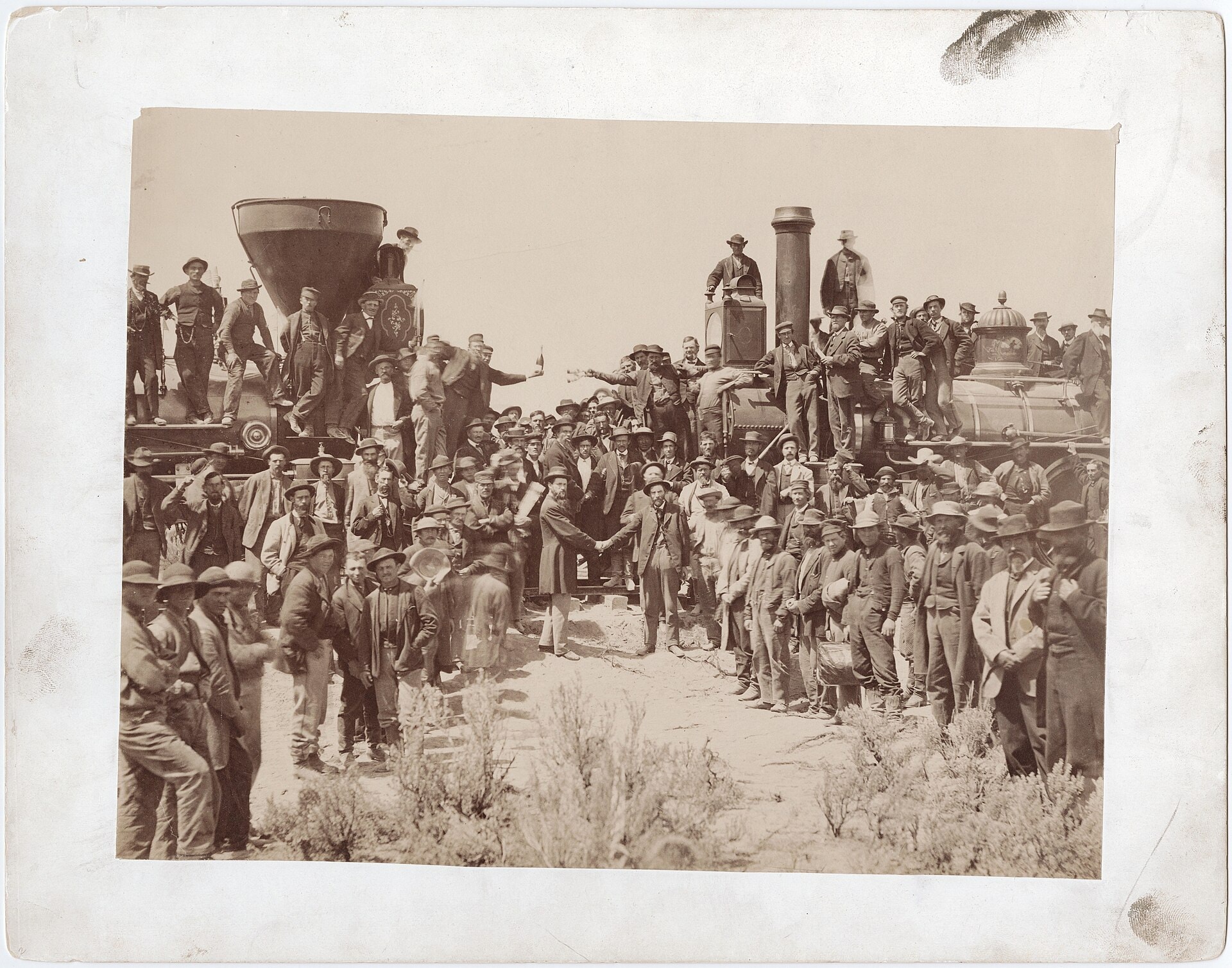
In 1869, two crews building toward each other met in a Utah desert and drove a golden spike. The coast-to-coast journey collapsed from six months to a week, and America became, overnight, a single country.
The Race to Promontory
The highway made the continent reachable. The railroad first made it possible.
In the middle of the Civil War, Abraham Lincoln signed the Pacific Railway Act of 1862, a bet that a nation tearing itself apart could simultaneously bind itself together with steel. The Central Pacific struck east from Sacramento into Sierra Nevada granite: fifteen tunnels blasted with black powder by some 15,000 Chinese laborers, whole winters spent working beneath the snow.
The Union Pacific struck west from Omaha across the Plains, war veterans and Irish immigrants laying a mile a day, then two, then, on one April day in 1869, ten miles and 56 feet, a record never equaled by hand. On May 10, 1869, at Promontory Summit, the two lines touched.
DONE.
The one-word telegram flashed to the entire nation the instant the hammer touched the golden spike, May 10, 1869. Bells rang from San Francisco to New York.
Three Ages of Steel
Watch the two lines of 1869 build toward each other, the great expansion of the 1880s, and today's freight titans. Touch a corridor for its story.
In the 1869 era the two routes draw toward each other: exactly as they were built.
Ctrl + scroll to zoom · drag to pan
Hover a corridor for its story

Chicago: Where All the Rails Meet
A quarter of America's rail freight passes through Chicago: roughly 500 freight trains a day, the interchange between the eastern and western networks since the 1850s. No other logistics junction on Earth resembles it.
The World's Most Efficient Freight Network
The double-stack revolution
In 1984 the first train carrying containers stacked two-high left Los Angeles. Doubling every railcar's capacity cut costs by a third and made American rail the backbone of transpacific trade.
The 1869 inheritance still works
Union Pacific's Overland Route follows the original 1860s survey for hundreds of miles. At North Platte, Nebraska, sits Bailey Yard: the largest railroad classification yard in the world, sorting 14,000 cars every day.
"I see over my own continent the Pacific railroad surmounting every barrier."