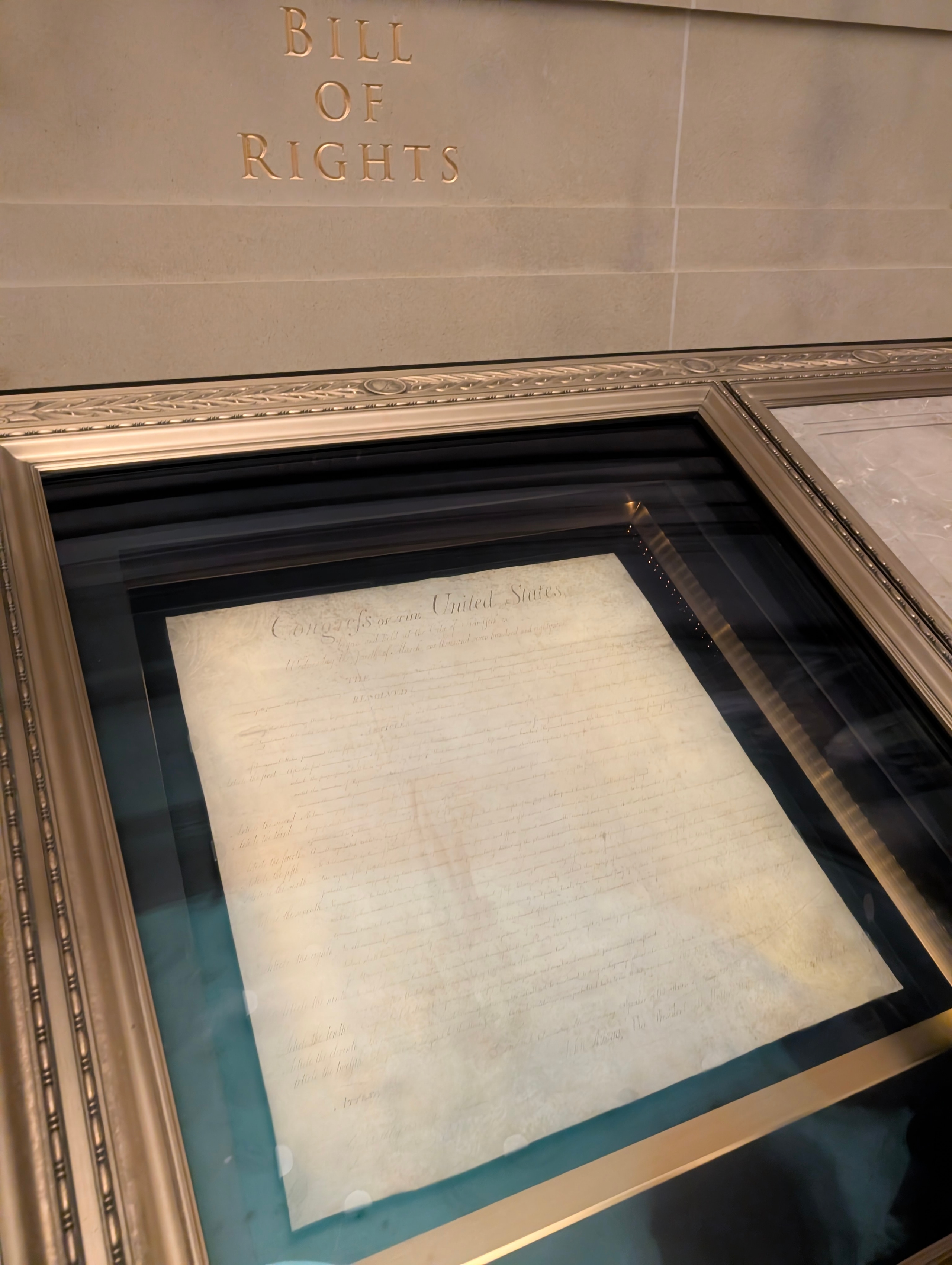
Amendment I
THE BROADESTFREE SPEECH ON EARTH
America protects speech other nations criminalize. Flag burning. Neo-Nazi marches. Offensive art. This is not an accident, it is a legal philosophy built over 200 years.
Original Text, Amendment I, Ratified December 15, 1791
“Congress shall make no law respecting an establishment of religion, or prohibiting the free exercise thereof; or abridging the freedom of speech, or of the press; or the right of the people peaceably to assemble, and to petition the Government for a redress of grievances.”
Five Freedoms in One Sentence
Free Speech
Government cannot punish you for criticizing it, even harshly, even offensively. The standard: imminent danger of illegal action.
Free Religion
No state religion and no interference with your faith. The reason America is paradoxically the most religious democracy.
Free Press
The press can publish government secrets if they serve public interest. Pentagon Papers (1971): the Times published against the White House's explicit wishes.
Free Assembly
You can protest, demonstrate, and advocate, even for causes the majority despises. KKK marches, neo-Nazi marches, anti-abortion protests, all protected.
Right to Petition
You can petition the government to redress your grievances. The foundation for lobbying, civic advocacy, and contacting elected representatives.
Defining Cases, How the Protection Was Built
The First Amendment did not emerge fully formed in 1791. It was sculpted case by case, over 100 years, often through unexpected rulings.
1919
Schenck v. United States
Government can restrict speech that creates 'clear and present danger'
First major First Amendment case, established initial limits on speech during wartime
1927
Whitney v. California
States can restrict speech advocating illegal acts
Justice Brandeis wrote the most powerful dissent for free speech in American history: 'If there be time to expose through discussion the falsehood and fallacies, to avert the evil by the processes of education, the remedy to be applied is more speech, not enforced silence.'
1964
New York Times v. Sullivan
Public officials must prove 'actual malice' to win defamation suits
Protects robust press coverage of government. No democracy offers broader defamation protection to journalists covering public officials.
1969
Brandenburg v. Ohio
Government can only restrict speech inciting 'imminent lawless action'
The modern First Amendment standard. Speech must be directed to producing and likely to produce imminent lawless action, a very high bar.
1989
Texas v. Johnson
Flag burning is constitutionally protected expression
5-4 decision that shocked many Americans. But the principle it upheld, that government cannot punish expression because it finds it offensive, is the cornerstone of free speech.
2010
Citizens United v. FEC
Corporations and unions may spend unlimited amounts in elections
The most contested First Amendment ruling of the modern era. 5-4. Held that political spending is protected speech. Critics argue it gave corporations constitutional personhood for speech purposes.
2017
Matal v. Tam
Government cannot refuse to register 'disparaging' trademarks
Unanimous court struck down a law banning 'disparaging' trademarks. The government may not discriminate against speech based on its viewpoint, even offensive viewpoints.
2023
303 Creative v. Elenis
First Amendment protects a web designer's right to decline same-sex wedding websites
6-3. The tension between free speech and anti-discrimination law, the defining First Amendment debate of the current era.
America vs. The World: Free Speech
Every democracy protects free speech in its constitution. No other democracy protects it as broadly as America.
Germany
Nazi symbols, Holocaust denial, and incitement to hatred are criminally prosecuted
Germany's experience with the Nazi regime shapes its approach to hate speech. The Basic Law protects free expression but prohibits speech that attacks human dignity.
United Kingdom
The Public Order Act and Racial and Religious Hatred Act restrict hate speech and offensive public expression
UK law balances free expression with public order and community harmony. Speech that 'causes harassment, alarm or distress' can be criminal.
Canada
Section 319 of the Criminal Code prohibits 'willful promotion of hatred' against identifiable groups
Canada's Charter protects freedom of expression but Parliament has limited hate speech. The Supreme Court has upheld hate speech laws as consistent with Charter values.
France
The Loi Pleven (1972) prohibits incitement to discrimination, hatred or violence based on origin, race, religion
France has extensive hate speech laws. Defamation of a group based on religion, race, ethnicity, or sexual orientation is a criminal offense.
United States
Speech can only be restricted when it presents a danger of imminent lawless action, a very high bar
The United States protects vastly more speech than any other developed democracy. Hate speech, offensive speech, Nazi symbols, Holocaust denial, all constitutionally protected.
""If there is any fixed star in our constitutional constellation, it is that no official, high or petty, can prescribe what shall be orthodox in politics, nationalism, religion, or other matters of opinion, or force citizens to confess by word or act their faith therein.""
The Visual Record
The Visual Record
Speech, press, faith, and assembly, the five freedoms of the First Amendment in action.
Martin Luther King Jr. Delivering the “I Have a Dream” Speech1963
King's march and speech show the First Amendment's freedoms of speech and assembly at their most powerful.
A Colonial Printing Pressc. 1770s
The colonial press spread revolutionary ideas and made freedom of the press a founding American value.
The March for Life in Washington, D.C.1974–Present
The annual March for Life shows the First Amendment rights of assembly and petition in sustained action.
The New York Times “Pentagon Papers” Headline1971
The Supreme Court's Pentagon Papers ruling was a landmark victory for freedom of the press.
The Pilgrims Landing at Plymouth Rock1620
The Pilgrims fled to America for religious freedom, a founding root of the First Amendment.