NORMAL AMERICANEXCELLENCE
Not Manhattan, not Beverly Hills: a standard affluent suburb like The Woodlands north of Houston already looks like science fiction next to a major European city. Free markets, secure property rights, and competent institutions build this physical reality.
Institutions First: Not Geography, Not Luck
The difference between a North-Houston suburb and a city like Iași stems from accumulated institutional capital built over generations, rather than natural resources or current income alone. Secure property rights, deep capital markets, functioning contract law, and a government that mostly facilitates private capital let wealth compound continuously. The Woodlands operates as a controlled experiment: a private developer planned the trails, parks, town center, and drainage with minimal state interference, demonstrating what markets optimize for when citizens are free to build.
The most underrated part is the price paradox. For tradable goods (electronics, cars, appliances, clothing) and especially fuel, American prices are frequently lower in absolute terms, even though the American worker earns several times more. The wage-adjusted gap is enormous: the same week of groceries that costs an American two hours of work costs far more labor-hours elsewhere, for an equivalent or lower-quality basket. Capital per worker, competition as a quality ratchet, and the franchise model standardizing quality across geography do the work no planning committee ever could.
Where the Difference Is Civilizational
Across domain after domain, the American baseline: the normal, unremarkable version, outclasses the best available in much of the developed world. A recurring lens: The Woodlands / north Houston versus Iași, Romania.
Retail & Grocery Scale
An H-E-B or Costco runs a supply chain among the most sophisticated in human history: bulk quantities, in-store sushi and tortillas, USDA-graded beef, year-round produce, at prices that embarrass most European hypermarkets.
Housing per Square Foot
A new ~2,400 sq ft single-family home with a garage and yard, on land that appreciates: versus a smaller, older apartment for a similar price per square meter. Permissive zoning and a deep construction industry make space ordinary.
Energy & Fuel
Texas produces, refines, and distributes its own energy in a competitive market. Gas often under $3/gallon versus a ~$6/gallon equivalent earned on a fraction of the wage: cheap energy quietly lowers the cost of everything else.
Healthcare & Equipment
The Texas Medical Center is the largest medical complex on Earth, 30 minutes away: robotic surgery, genomic medicine, clinical trials, and drugs that won't reach many countries for years. (With the honest caveat of billing for the uninsured.)
Logistics & Delivery
Amazon next-day, sometimes same-day, to a suburban address, on a fulfillment network of hundreds of warehouses. Any product in America arrives within 48 hours, usually free.
Business Formation
An LLC in ~20 minutes online for a few hundred dollars; a business bank account the same week; a thick ecosystem of accountants, lenders, and investors that says, plainly: we want you to build here.
Financial Products
The 30-year fixed mortgage turned homeownership into a middle-class norm; rewards credit cards and a credit-score system let ordinary people capture real value and borrow to build economic lives.
Youth Sports Facilities
A Texas public high school football stadium seating 10,000–20,000, with pro-grade turf, lighting, and a weight room: funded by a local tax base that actually generates revenue.
Opportunity & Wages
A new-grad software engineer earns $140–180k plus benefits where the same role abroad pays a fraction: same company, same work, multiples of the compensation, in a no-state-income-tax environment.
Everyday Services
Drive-throughs, apps, and an on-demand economy built on the assumption your time is worth something: Uber, DoorDash, Instacart, and a customer-service culture sharpened by public reviews.
Dining & Restaurants
Within five miles of any suburb: authentic pho, Tex-Mex refined over generations, ramen, Indian buffets, steakhouses, and a dozen fast-casual chains each optimized by billion-dollar R&D: density and variety at every price point.
Delivery & Logistics
Amazon Prime next-day (often same-day), built on hundreds of fulfillment centers and the UPS/FedEx/USPS backbone. Elsewhere, 'delivery' means a 5–10 day wait and a courier fee.
Home-Improvement Ecosystem
Home Depot and Lowe's each stock 30,000–40,000 SKUs, fueling a culture where capital flows continuously into homes: bigger, better-equipped, continuously upgraded because the financing and products both exist.
The Pet Economy
A ~$150B industry: PetSmart and Petco with in-store vet clinics, grooming, and training; veterinary oncology and surgery at a standard that reflects the country's wider scientific depth.
Customer-Service Culture
Costco's no-questions return policy is an institution. Reinforced by Yelp and Google reviews, businesses compete on satisfaction: the baseline expectation that a problem will simply be fixed.
Aviation & Airports
Two major international airports per metro, $80–200 domestic flights, TSA PreCheck and Global Entry, and general-aviation fields where middle-class people own small planes: mobility at a scale that reshapes what opportunities are even visible.
Outdoor Recreation
Maintained trails, proper campsites with hookups, ranger stations, and Bass Pro / Cabela's superstores: lakes, gulf coast, and national parks within a day's drive, all to a standard that makes the experience effortless.
Normal Excellence, Repeated
The Woodlands is not an exception. The same baseline: infrastructure, housing, retail, opportunity: repeats across dozens of metros throughout the Sun Belt and beyond. A few of them.
The Pattern Isn't One City
Beyond north Houston, these metros each show a different dimension of the same American abundance: corporate migration, tech capital, no-income-tax growth, and outdoor-lifestyle booms.
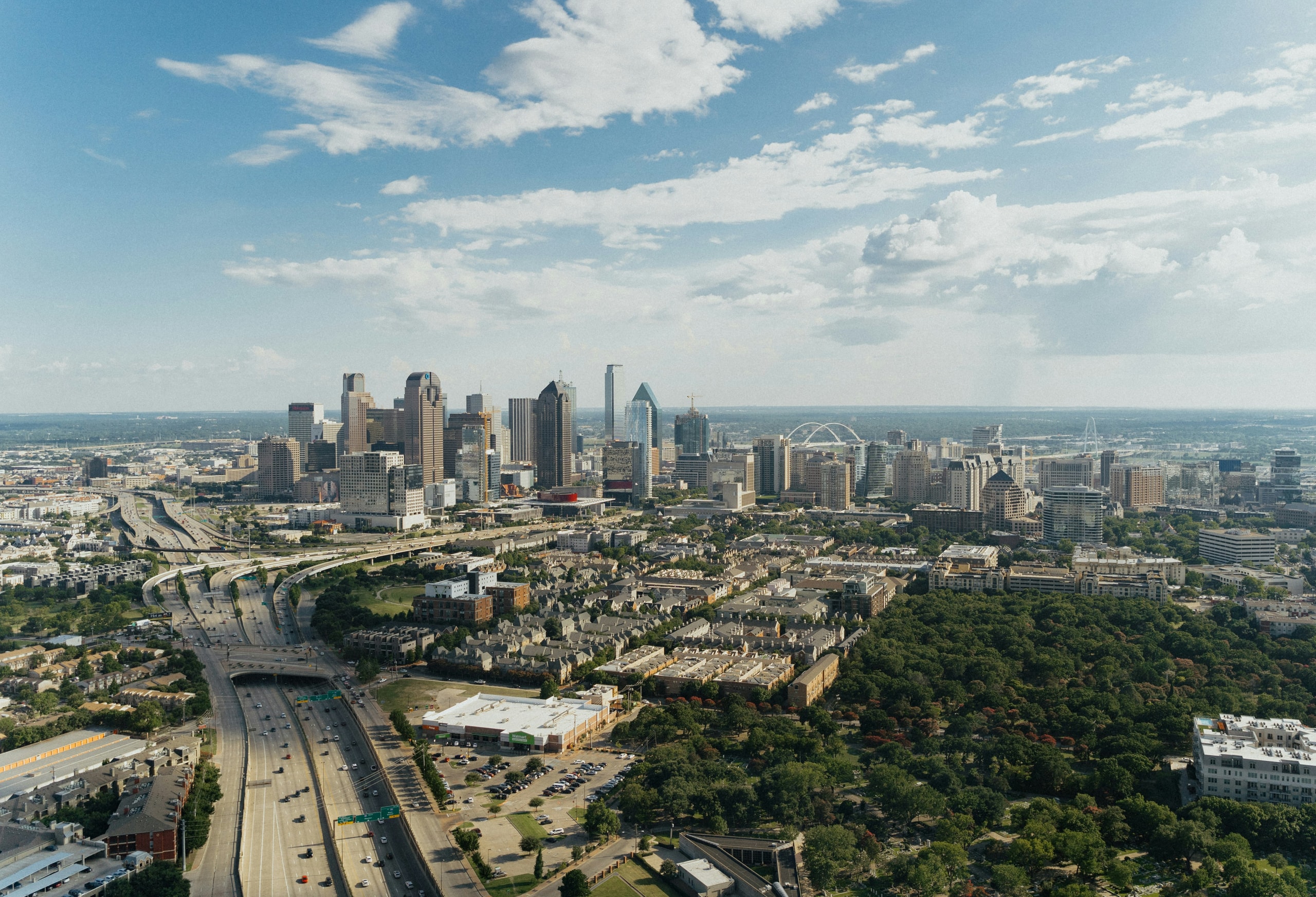
Dallas–Fort Worth / Frisco, TX
The corporate-relocation magnet: Toyota, Goldman Sachs, Charles Schwab. Frisco is among America's fastest-growing, best-resourced suburbs.
Austin, TX
Apple, Tesla, Oracle, and SpaceX operations: Silicon Valley money meeting the Texas regulatory environment.
Nashville, TN
No state income tax, booming healthcare and tech, exploding suburbs: proof the pattern holds well outside Texas.
Charlotte, NC
A finance hub anchored by Bank of America, one of the fastest-growing major metros, affordable next to the Northeast.
Salt Lake City / Provo, UT
'Silicon Slopes': world-class outdoor recreation, clean and family-friendly, with a booming tech scene.
Phoenix / Scottsdale, AZ
Sun Belt growth in desert form: master-planned communities, year-round golf, corporate campuses, no state income tax.
Raleigh–Durham, NC
The Research Triangle: three major universities, pharma and biotech, suburban quality of life at still-reasonable prices.
Tampa / Orlando / Jacksonville, FL
The Florida corridor: no state income tax, explosive growth, aerospace, Disney, finance, and waterfront living.
The Price–Wage Paradox
The argument becomes unanswerable when you hold prices fixed. Americans earn several times more in real terms, yet pay the same or less for most tradable goods: and dramatically less for fuel.
Average annual wage, PPP-adjusted (US$)
Source: OECD Average Wages (PPP)
Gasoline price (US$ per gallon): lower is better
Pump price for premium-grade fuel, recent annual average.
Source: GlobalPetrolPrices
Residential electricity price (¢/kWh): lower is better
Average household rate.
Source: GlobalPetrolPrices / Eurostat / EIA
Average new-home size (m²)
Source: US Census / national statistics
North Houston vs. Iași: the same wallet, a different life
Representative figures; rounded for comparison.
Same Ambition, Different Platform
Comparing the same intelligent, hard-working person in north Houston versus Iași highlights a functioning platform versus constant friction.
Age 22–24 · The Launch
North Houston / The Woodlands
Junior role in tech/energy/medical devices at $70–85k, zero state income tax. A modern one-bedroom with a pool and gym. A used F-150 financed at 4–5%, a $45 tank, a $120 weekly grocery run. Already contributing to a 401k with an employer match and a Roth IRA: building tax-advantaged wealth at 23.
Iași, Romania
A good local job pays €1,000–1,600/month. A 45 m² flat in a 1970s block, street-parking chaos, a used Dacia. Health cover exists on paper but means a three-week wait and dated equipment. No 401k, no Roth, no five-minute index fund: a generation behind in the wealth-building toolkit.
Age 26–30 · The Acceleration
North Houston / The Woodlands
$110–160k. Buys a 2,400 sq ft house in Katy or Cypress for ~$320k, building equity every month. Maxes retirement accounts, invests the surplus, maybe forms an LLC in an afternoon. Drives a new truck on highways that work, 20-minute commute.
Iași, Romania
Doing well by local standards at €2,500–3,500/month: top 5–10% of earners. Maybe buys an €80–120k apartment. But the ceiling is visible: the best local employer still pays local rates, and bureaucracy taxes every plan: a routine permit can take six months.
Age 32–40 · The Divergence
North Houston / The Woodlands
Senior engineer or director, $160–220k plus bonus. Net worth approaching $400–600k across home equity, retirement, and brokerage: still climbing. Excellent public schools, two or three real vacations a year, an environment that compounds ambition.
Iași, Romania
Exceptional and earning €4,000–5,000: a genuinely good Romanian life. But the Houston counterpart, same skills, has a $190k salary, a $450k house with $120k equity, and $280k in retirement accounts. The cumulative gap over those years is not a rounding error: it is a different life.
Same Ambition, City by City
Pairing each American city with its closest global counterpart reveals how identical ambition performs on two distinct platforms.
The flagship comparison: master-planned suburban excellence against a post-communist university city. The most dramatic gap on the page: the emotional anchor of the whole section.
Both their region's rising star, full of energy and ambition. But Warsaw's wages and institutional ceiling sit in another universe: ambition on a smaller platform.
Both the 'cool alternative' tech-and-music city. Berlin's bureaucracy is legendary and German taxes punishing; Austin pulled in roughly 10× the venture capital.
Music cities and healthcare hubs with underdog-to-powerhouse energy. But NHS waits and post-Brexit wage stagnation make Nashville the more viable place to build a career.
Mid-size banking cities. The Dutch 52% top tax rate and Amsterdam's housing crisis versus Charlotte's still-affordable, explosive growth.
Outdoor-recreation capitals with university ecosystems. Munich's housing runs €7,000–12,000/m²; SLC stays affordable under a far lighter tax burden.
Engineered desert prosperity. But Dubai offers no path to citizenship and runs on migrant labor without rights: wealth with institutions versus wealth without them.
University-driven innovation ecosystems. Sweden's 50%+ marginal rates and a 10-million-person market versus the Triangle's expansion into a 330-million one.
Beloved sunshine cities. But Barcelona carries 25%+ youth unemployment and wages that don't match its cost of living; the Florida corridor runs on no state income tax and explosive job creation.
A century-long rivalry for the title of world's financial center. Post-Brexit the gap widened: NY finance pay now outruns London for the same roles, and talent has shifted visibly westward.
Sun-drenched creative megacities built around the good life. But Sydney's housing is among the world's least affordable by wage multiples, and the opportunity argument still favors LA despite its dysfunction.
Tech triangles built on anchor giants: Amazon and Microsoft versus Samsung and LG. But Seoul's chaebol rigidity, exam pressure, and housing costs make Bellevue's entrepreneurial path the freer one.
How the Other Regions Stack Up
The honest version of the comparison includes the sophisticated competitors alongside standard examples. Region by region, the same conclusion keeps surfacing: institutions, not geography or resources, set the ceiling.
Eastern Europe
Prague, Budapest, Sofia, Belgrade, Kyiv, Moldova: even the best post-communist transitions reach only a fraction of US wages, with thin capital markets and EU taxes without EU incomes.
Western Europe
Munich, London, Paris, Amsterdam, Brussels, the Nordics, Switzerland: genuinely good, but 45–60% effective tax burdens, severe housing costs, and private-sector pay below US equivalents. Switzerland is the honest near-tie.
Latin America
São Paulo, Mexico City, Buenos Aires, Medellín: real pockets of world-class infrastructure surrounded by inequality, security costs, and institutional volatility.
Asia-Pacific
Tokyo, Seoul, Shanghai, Bengaluru, Singapore, Sydney: impressive and modern, yet constrained by stagnant wages, weak property rights and surveillance (China), or extreme housing costs (Singapore, Sydney).
Middle East & Africa
Dubai, Abu Dhabi, Riyadh, Tel Aviv, Cape Town: oil and ambition can buy infrastructure, but not the institutions: citizenship, property rights, security: that let American prosperity compound.
The Honest Caveats
- American healthcare quality is world-class, but the billing and insurance around it is a real risk for the uninsured: the gap closes once you're inside a strong employer plan.
- Romanian urban fiber internet is genuinely fast: often faster than US residential broadband. Infrastructure is not uniformly behind.
- Iași's 500-year-old architecture, monasteries, and old city center have cultural value a Texas suburb simply does not possess. The trade-off is real and worth naming.
- The gap is institutional and systemic, not a matter of people 'putting up with' worse: it has precise, well-understood causes, and the right individual decisions can bridge it.
The Takeaway
The American baseline represents the normal affluent expectation repeated across the Sun Belt. Private capital, competitive markets, the rule of law, and supportive government institutions deliver capitalism as advertised. Its underlying causes are replicable in principle, rendering the comparison instructive for policy and individual decisions.
The Ask America Oracle
Ask the AI Oracle about purchasing-power parity, the 30-year fixed mortgage, capital per worker, or why American retail prices are often lower in absolute terms.