Yellowstone National Park
THE WORLD'SFIRST PARK
The world's first national park, established 1872. Over 10,000 hydrothermal features, more than the rest of the world combined. The largest free-roaming bison herd in North America. And a supervolcano beneath it all.
0
Established
0+
Hydrothermal Features
0+
Geysers
0+
Wild Bison
10,000 Hydrothermal Features
Beneath Yellowstone lies a partly molten magma reservoir just 2–5 miles underground. Surface water seeps down, heats up, and returns as the most spectacular thermal display on Earth. Yellowstone contains over 500 geysers, representing half of the world's total.
Feature Types
Old Faithful erupts every 44–125 minutes, 100–180 ft high
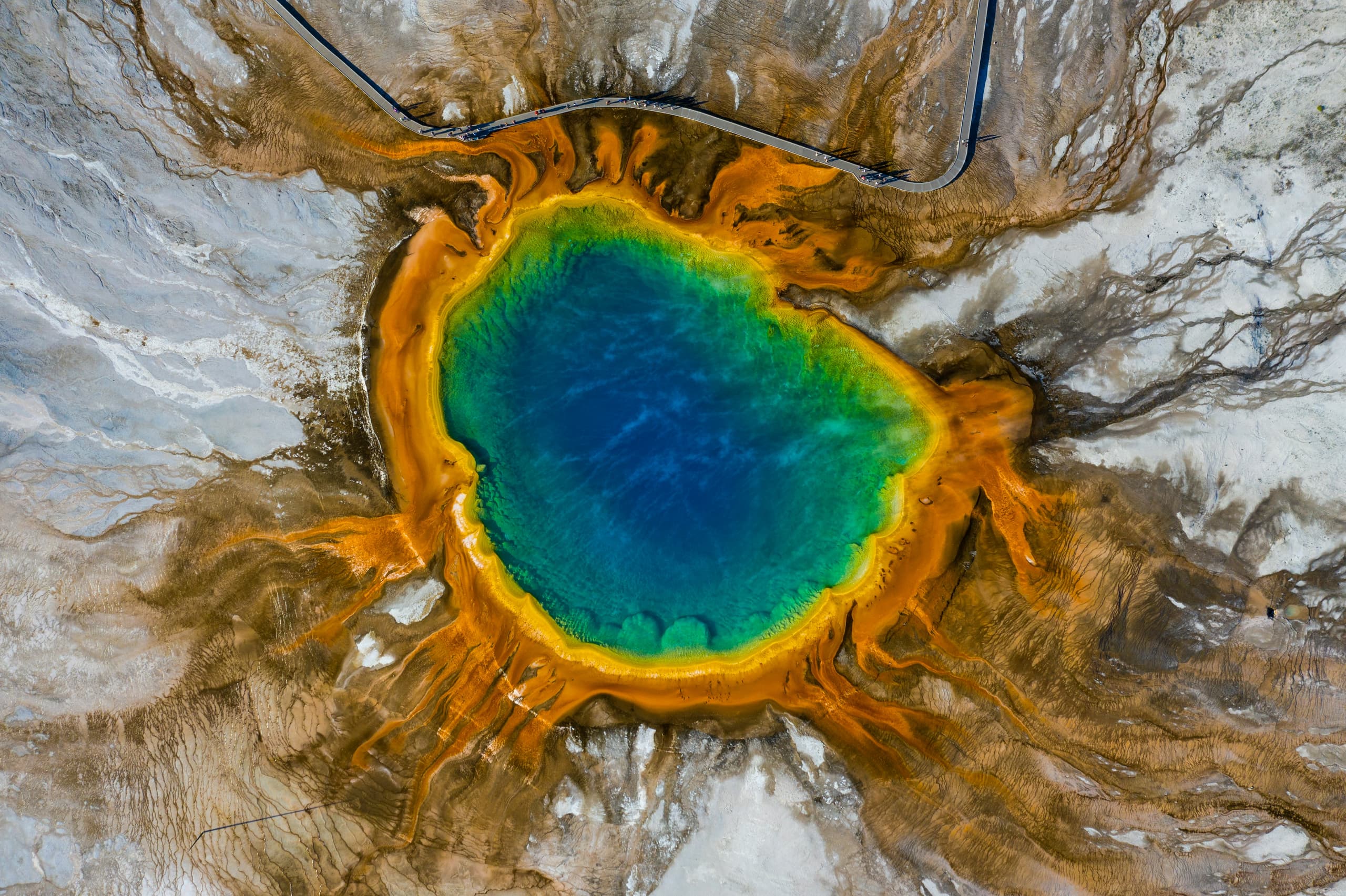
Grand Prismatic Spring: largest hot spring in the US, 370 ft wide
Bubbling pools of acidic clay, some so acidic they dissolve rock
Steam vents releasing SO₂, H₂S, CO₂ from magma 2–5 miles below
Mammoth Hot Springs: a constantly changing calcium carbonate formation
1872
The World's First National Park
An American idea that inspired conservation around the world
Megafauna
| Animal | Population |
|---|---|
| American Bison | 5,000–6,000 |
| Gray Wolf | 100–130 |
| Grizzly Bear | 700+ |
| Elk | 10,000–20,000 |
| Black Bear | 600+ |
| Pronghorn | 200–400 |
In Detail
Yellowstone has more hydrothermal features than the rest of the world combined
Over 10,000 geysers, hot springs, fumaroles, and mud pots: the result of a massive volcanic hotspot beneath the park. Half of all the world's geysers are in Yellowstone.
Yellowstone was the world's first national park: established in 1872
When President Ulysses S. Grant signed the Yellowstone National Park Protection Act, it was the first time any government in history had set aside land specifically for public enjoyment and preservation.
Yellowstone has the largest bison herd in North America: 5,000+ animals
After near-extinction in the 1890s (fewer than 100 bison survived), Yellowstone's herd has recovered to 5,000–6,000, the largest wild bison herd on Earth.
Yellowstone sits atop a supervolcano capable of reshaping a continent
The Yellowstone Caldera is one of the largest supervolcanic systems on Earth. Its last full eruption, 640,000 years ago, deposited ash across half of North America.
Wolf reintroduction changed Yellowstone's rivers: a trophic cascade
When wolves returned in 1995, they changed elk behavior, which allowed riverbanks to revegetate, which reduced erosion, which changed river courses. One of the most famous ecology case studies ever.
Yellowstone's hot springs led to a revolution in biology and medicine
Thermus aquaticus, discovered in Yellowstone hot springs, provided Taq polymerase, the foundation of PCR technology, used in COVID testing, DNA forensics, and every modern genetics lab.
Yellowstone's magma chamber could power all US electricity for 30,000 years
The supervolcano system contains ~240 cubic miles of partly molten rock. Its last full eruption 640,000 years ago deposited ash across half of North America.
“Yellowstone serves as a window into geological time, a living laboratory of evolution, and proof that nature heals itself magnificently.”
: E.O. Wilson