
TRUSTTHYSELF
Emerson, Thoreau, and the New England revolt against social conformity. The argument that the individual conscience outranks the crowd.
A philosophy of absolute independence
Transcendentalism emerged in New England in the 1830s as a revolt against religious formalism and industrial materialism. It argued that truth is found not in books or churches, but directly through intuition and communion with nature. At its core lies a radical belief: the individual carries a divine spark within and has a duty to obey their own conscience, even when all of society demands otherwise.
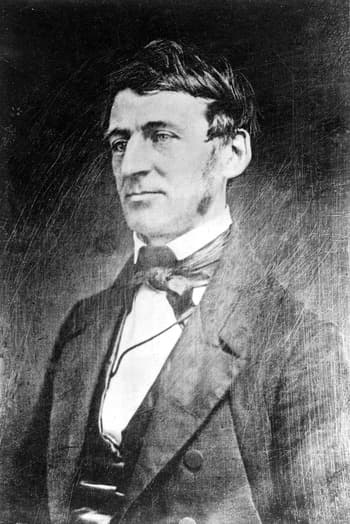
Emerson and Self-Reliance
Ralph Waldo Emerson's 1841 essay, 'Self-Reliance,' was the manifesto of American individualism. The passage below contains his famous exhortation. Click any underlined phrase to explore its argument.
There is a time in every man's education when he arrives at the conviction that envy is ignorance; that imitation is suicide; that he must take himself for better, for worse, as his portion; that though the wide universe is full of good, no kernel of nourishing corn can come to him but through his toil bestowed on that . The power which resides in him is new in nature, and none but he knows what that is which he can do, nor does he know until he has tried. .
Pick an underlined phrase to explore Emerson's manifesto of individualism.
If a man does not keep pace with his companions, perhaps it is because he hears a different drummer. Let him step to the music which he hears, however measured or far away.

Thoreau and Deliberate Living at Walden
In 1845, Henry David Thoreau retired to a cabin he built himself on the shores of Walden Pond in Massachusetts. His experiment was a systematic reduction of life to its essential elements, proving that a person could free themselves from the slavery of repetitive labor and social convention.
I went to the woods because I , to , and see if I could not learn what it had to teach, and not, when I came to die, discover that I had not lived. I did not wish to live what was not life, living is so dear; nor did I wish to practise resignation, unless it was quite necessary. I wanted to live deep and ...
Pick an underlined phrase to analyze Thoreau's reflections on his Walden experiment.
Civil Disobedience and its global legacy
The New England rebellion did not remain in the woods. Thoreau's 1849 essay 'Civil Disobedience': written after he was jailed for refusing to pay a poll tax in protest of slavery and the Mexican-American War: argued that the individual's moral duty outranks the laws of the state. If a law requires you to be an agent of injustice to another, he wrote, 'then, I say, break the law.' This single essay traveled across continents and decades. It became a primary text for Mahatma Gandhi's campaigns in India and Martin Luther King Jr.'s civil rights movement in America, demonstrating how a philosophy of individual conscience can rewrite the history of nations.
Primary Source Library & eBooks
Download complete digital editions (EPUB format) of key classic works relevant to this chapter.
Nature
Ralph Waldo Emerson
Self-Reliance
Ralph Waldo Emerson
Walden
Henry David Thoreau
Imagery: 19th-century portraits and manuscript scans in the public domain, via Wikimedia Commons.
← All literature and philosophy topics