TWOMINUTES
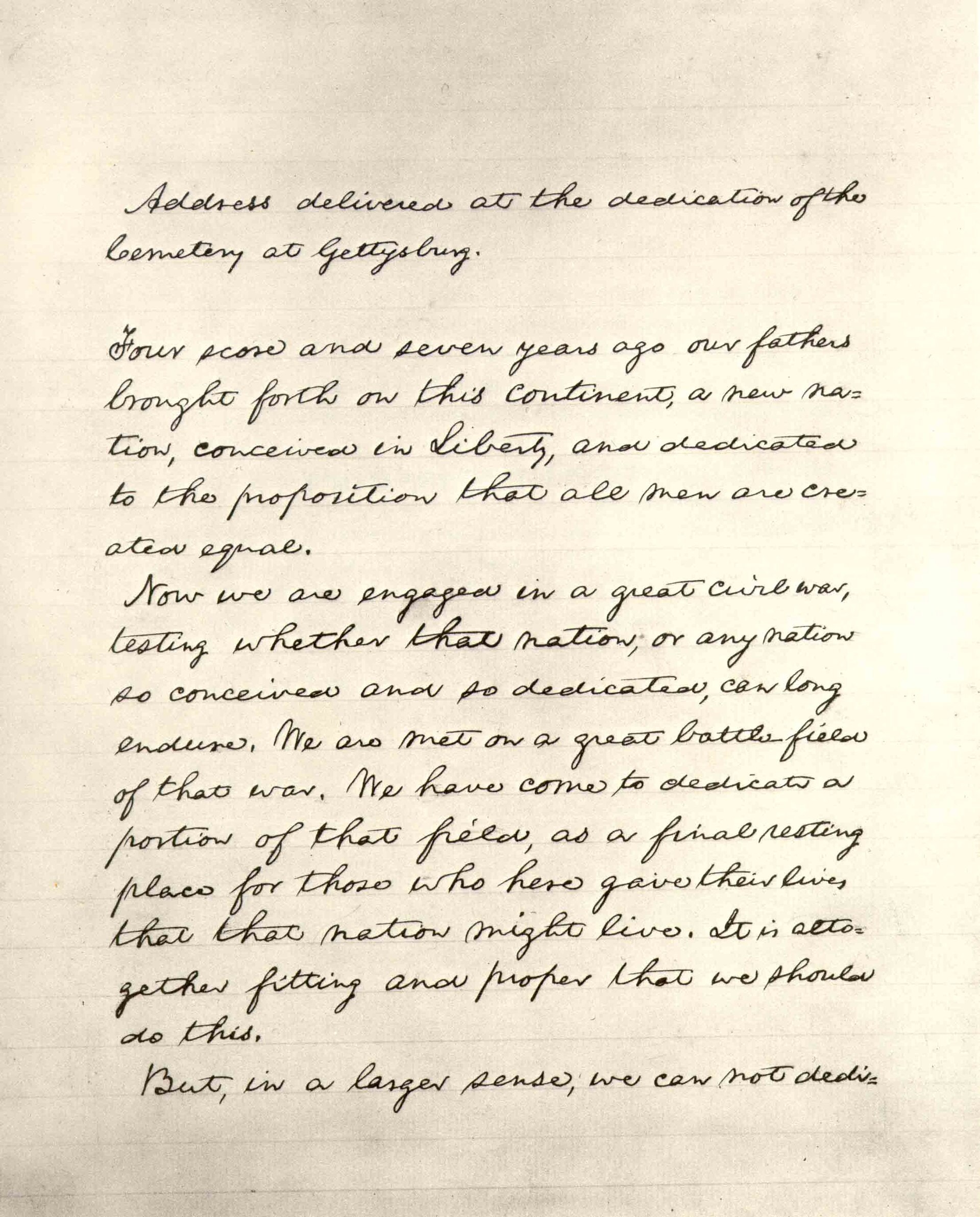
The Gettysburg Address is 272 words. The orator who spoke before Lincoln spoke for two hours, and nobody remembers a single word of it.
American oratory is a written form
The speeches that lasted were not improvised. They were composed: revised, timed, built sentence by sentence by people who knew exactly what each word was doing. Lincoln wrote his address before leaving for Gettysburg and revised it the night before he gave it. Douglass prepared his 1852 attack for months. What we call American oratory survives because it was literature first.
The address, taken apart
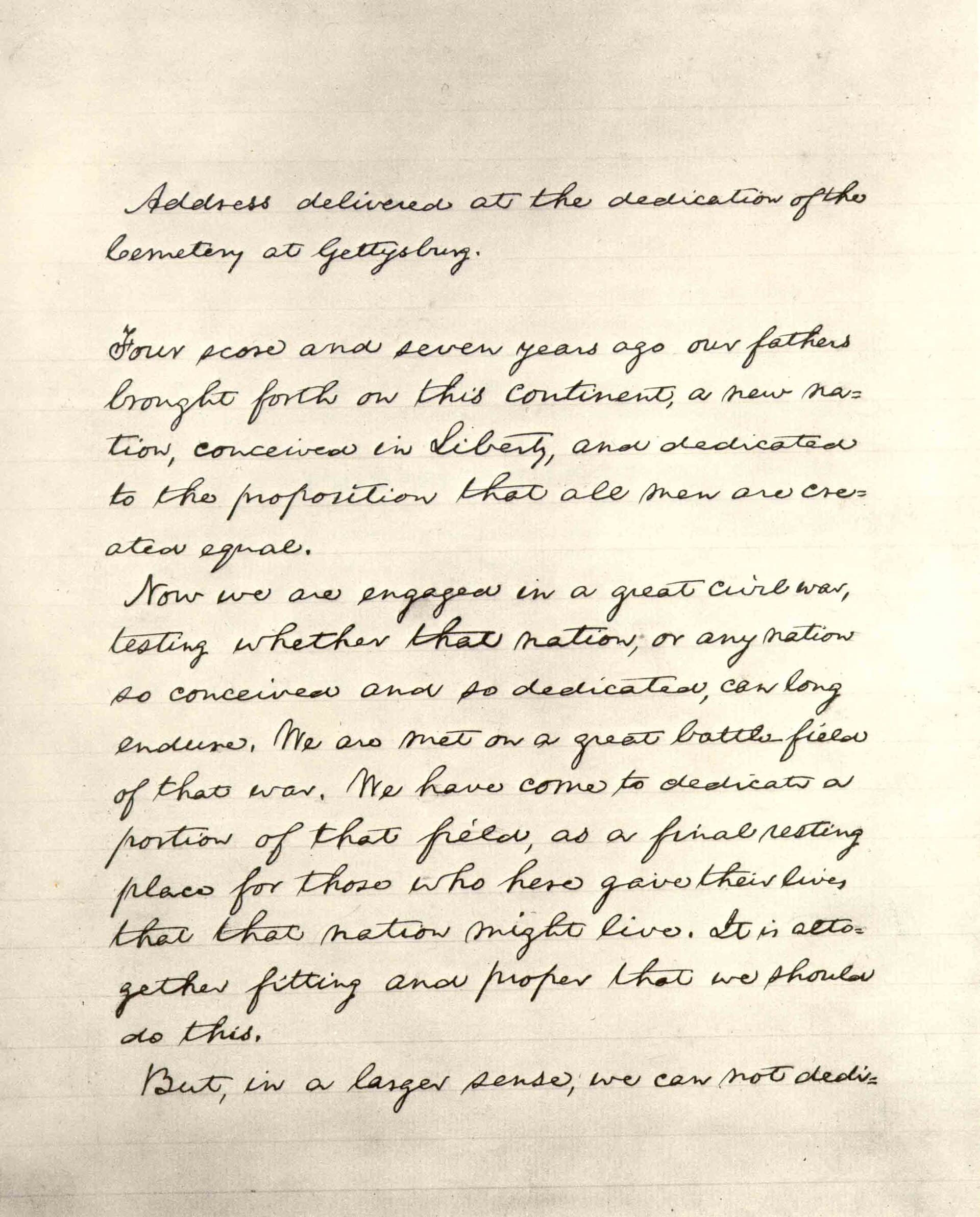
The text below is the Bliss copy, the only version Lincoln signed and the one carved at the Lincoln Memorial. Click any underlined phrase to see what it is doing.
our fathers brought forth on this continent, a new nation, , and dedicated to the proposition that . Now we are engaged in a great civil war, testing whether that nation, or any nation so conceived and so dedicated, can long endure. We are met on a great battle-field of that war. We have come to dedicate a portion of that field, as a final resting place for those who here gave their lives that that nation might live. It is altogether fitting and proper that we should do this. But, in a larger sense, we can not dedicate: we can not consecrate: we can not hallow: this ground. The brave men, living and dead, who struggled here, have consecrated it, far above our poor power to add or detract. , but it can never forget what they did here. It is rather for us to be here dedicated to the great task remaining before us: that from these honored dead we take increased devotion to that cause for which they gave the last full measure of devotion: that we here highly resolve that these dead shall not have died in vain: that this nation, under God, shall have : and that government , shall not perish from the earth.
Pick an underlined phrase. Each one is doing something different: dating the nation, moving a metaphor, borrowing a cadence.
I celebrate myself, and sing myself, / And what I assume you shall assume.
And then the line breaks
In 1855 Walt Whitman self-published a book with no author name on the cover, written in lines that did not rhyme and obeyed no English meter. American poetry never went back. What Lincoln did to the cadence of a sentence, Whitman did to the shape of a poem: broke it off the British template and built something that sounds like speech.
The other tradition
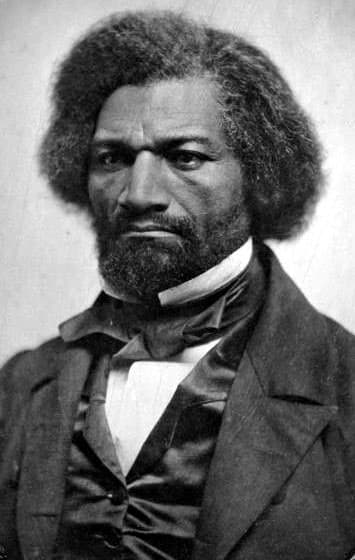
Eleven years before Gettysburg, Frederick Douglass was invited to speak on the Fourth of July and asked his audience why they had invited him. The speech is the finest American example of praise turned into indictment: it spends its first third genuinely honouring the Founders, then turns every bit of that respect against the people listening.
"What to the Slave is the Fourth of July?": Douglass, Rochester, New York, 5 July 1852.
This Fourth of July is yours, not mine. You may rejoice, I must mourn.
The inheritance, and why it stops here
The line runs forward: Lincoln at Gettysburg, Douglass at Rochester, and then Martin Luther King Jr. on the steps of the Lincoln Memorial in 1963: standing deliberately beneath Lincoln's words and opening with "Five score years ago", a direct echo of Lincoln's biblical arithmetic. We cannot quote King at length here. "I Have a Dream" was delivered in 1963, remains under copyright, and the King estate actively enforces it. The Lincoln, Douglass and Whitman texts on this page are public domain, which is exactly why you can read them in full.
Primary Source Library & eBooks
Download complete digital editions (EPUB format) of key classic works relevant to this chapter.
Leaves of Grass
Walt Whitman
Democratic Vistas
Walt Whitman
Common Sense
Thomas Paine
The Rights of Man
Thomas Paine
The Federalist Papers
A. Hamilton, J. Jay, J. Madison
Notes on the State of Virginia
Thomas Jefferson
Washington's Farewell Address
George Washington
Democracy in America
Alexis de Tocqueville
Imagery: public domain, via Wikimedia Commons.
← All literature and philosophy topics